
Until 1993, it was not a requirement in the United States for a clinical trial to include female test subjects [1]. Because of this historical lack of representation in medical research, the female body remains a mystery to doctors and is surrounded by misconceptions to the average person. From the ovaries to fertilization to menopause, here are six things about the female body 90% of the population likely does not know about 50% of the population.
The Ovaries:
Common Misconceptions
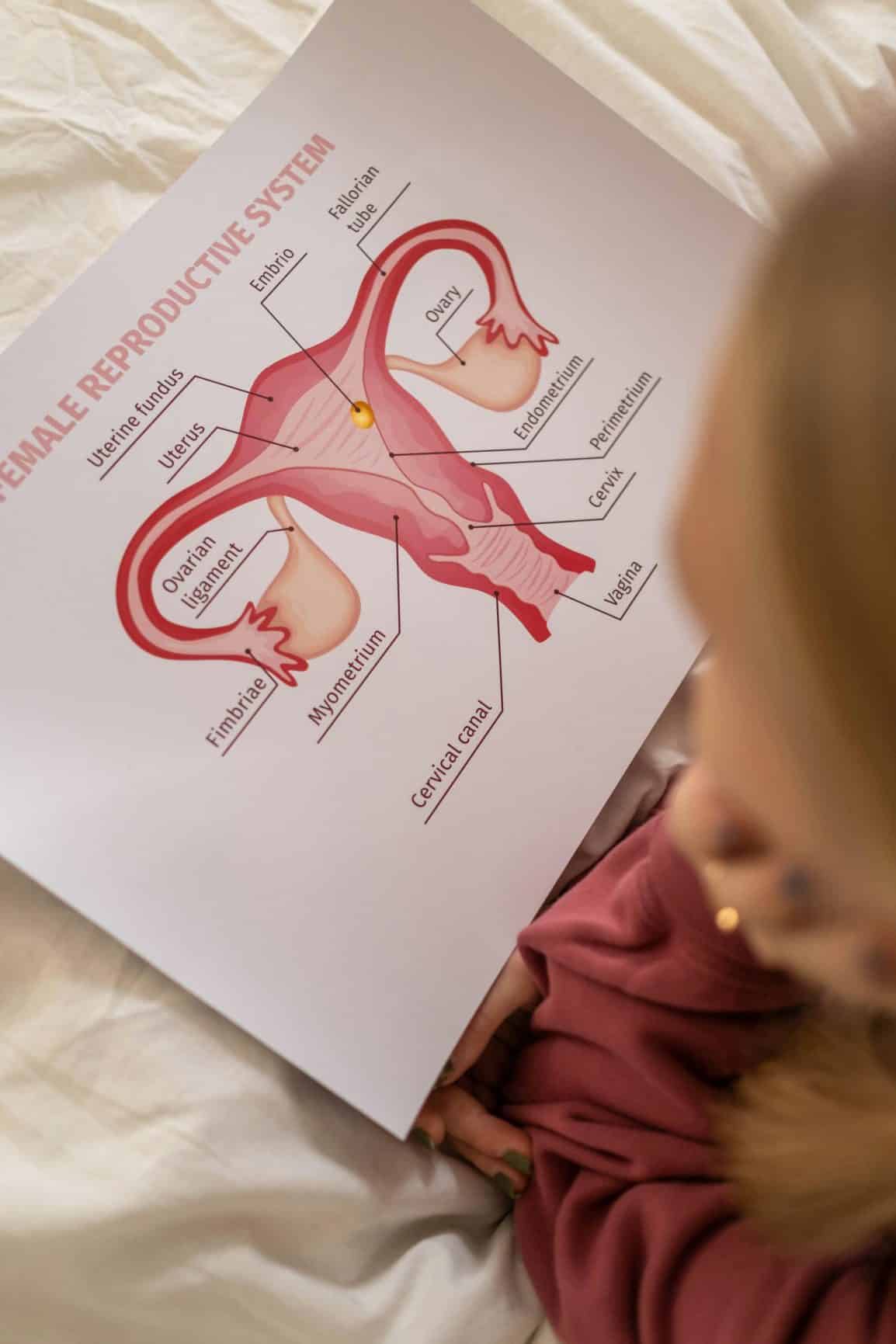
Most of the misconceptions about the ovaries do not come from what people have been told about the ovaries, but rather what they have not been told. For example, the image that is often shown of the ovaries depicts the ovaries laid out to see their connection to the uterus, fallopian tubes, vagina, and cervix. However, the ovaries are much more compacted together and are the size of a kiwi, but can vary in size based on the menstrual cycle. Over the ovaries, there is a healthy protective layer of fat called the omentum that no amount of sit-ups could or should work off.
Menstruation
Additionally, what causes discomfort during menstruation is not some mythical punishment, but rather the uterus taking care of itself. You see, six to ten days before ovulation – the ~24-hour period in which pregnancy is possible, an egg will travel from the ovary through the fallopian tube and rest in the tissue of the uterus [2]. The travel of the egg might cause some discomfort known as mittelschmerz [3], but the famous period pain comes from the tissue of the uterus. After the ovulation window has passed without fertilization, the uterus will shed the old tissue lining and replace it with fresh tissue. This means that what comes out of the vagina during menstruation is not just blood but rather a mix of tissue, mucus, blood, and other general fluids.
Like mittelschmerz, this might cause some discomfort but should not cause debilitating pain. If you find yourself unable to function during this process, it is important to immediately check in with your doctor. Although this pain may be caused by lifestyle habits, such as a poor diet or exercise, it can also be an underlying condition, such as a uterine fibroid, endometriosis, or pelvic inflammatory disease.
Hysterectomies
Another misconception surrounding the ovaries is a hysterectomy [4]. Hysterectomies can be performed for a number of reasons, such as cancer, personal choice, or fibroids. There are several kinds of hysterectomies possible, ranging from the simple removal of the uterus to the near-complete removal of the ovaries. After any hysterectomy, menstruation and pregnancy will not be possible. It is important to note that hysterectomies performed on females pre-menopause will often keep the ovaries, as one of their many purposes includes the regulation and distribution of hormones such as estrogen and testosterone [5].
Fertilization:
The race of the sperm overwhelming the passive egg is one of the biggest fables around female anatomy. In reality, the sperm cannot do anything until the uterus and fallopian tubes process it through capacitation. After that, the sperm is directed to the egg by the egg in a chemical process called sperm chemotaxis. From there, the egg has its pick of the litter and selects a sperm via the zona pellucida. Once fertilized, the egg will transform its membrane to prevent any other sperm from coming in. This process is far from the myth of the heroic race of the sperm; it is a testament to the strength and power of the egg. [6].
Although the egg does its best to choose the best sperm, when given a poor selection of sperm, there is only so much the egg can do. Up until very recently, it was assumed that the sperm was the dominant leader of the fertilization process, but simultaneously bore no responsibility if something went wrong. All miscarriages, birth defects, and infertility were assumed to be the woman’s fault. And yet, Dr. Channa Jayasena found that men whose partners miscarried had twice as much DNA damage to their sperm compared to men whose partners did not miscarry. Miscarriages and general infertility often occur when the carrier’s body thinks for a moment that the mother’s life is in danger. When a couple has difficulty conceiving, it is not because the mother’s body is failing, but rather that it is doing everything it can to keep the mother safe. [8].
Menopause:
Like the ovaries, the misconceptions around menopause are not from misinformation but the lack of information. Despite being something that half of the population experiences, the causes of menopause are wildly under-researched. For example, after menopause, women can lose up to 20% of their bone density [9], lose up to a third of their muscle mass [10], and women make up two-thirds of older individuals with Alzheimer’s [11]. All of these ailments are blamed on changes in hormones, and while that certainly does contribute to these changes, it is interesting how men’s hormones change with age as well, yet the effects of those changes are not half as detrimental.
Understand Your Body:
Many women go into puberty, menstruation, pregnancy, and menopause without the slightest idea as to what is happening in their bodies. This lack of knowledge is based on both the lack of education about women’s bodies and the lack of knowledge about them. While these were just a few trivial facts, there is a whole body of knowledge that is yet to be discovered about the female body. When women understand their bodies, it not only makes them safer, but it also makes it almost impossible not to be amazed at the wonders they perform every day without even doing anything.
Works Cited:
1.
“Why We Know So Little About Women’s Health.” University of Utah Health, Jan. 2025,
https://uofuhealth.utah.edu/notes/2025/01/why-we-know-so-little-about-womens-health.
2.
“Signs Ovulation Is Over.” Flo Health,
https://flo.health/getting-pregnant/trying-to-conceive/tracking-ovulation/signs-ovulation-is-over.
3.
“Mittelschmerz – Symptoms and Causes.” Mayo Clinic, 13 Feb. 2024,
https://www.mayoclinic.org/diseases-conditions/mittelschmerz/symptoms-causes/syc-20375122.
4.
“Hysterectomy.” Cleveland Clinic,
https://my.clevelandclinic.org/health/procedures/hysterectomy.
5.
“Ovaries: What to Know.” WebMD,
https://www.webmd.com/women/ovaries-what-to-know.
6.
“Events of Fertilization.” Encyclopaedia Britannica,
https://www.britannica.com/science/fertilization-reproduction/Events-of-fertilization.
7.
Jayasena, Channa. Imperial College London,
https://profiles.imperial.ac.uk/c.jayasena.
8.
“Recurrent Miscarriage Linked to Faulty Sperm.” Imperial College London,
https://www.imperial.ac.uk/news/189690/recurrent-miscarriage-linked-faulty-sperm/.
9.
“Bones and Menopause.” Women’s Health Network,
https://www.womenshealthnetwork.com/bone-health/bones-menopause/.
10.
“Best Way to Work Out After Menopause.” UCLA Health,
https://www.uclahealth.org/news/article/best-way-work-out-after-menopause.
11.
“Menopause and Memory: Know the Facts.” Harvard Health Publishing, 3 Nov. 2021,
https://www.health.harvard.edu/blog/menopause-and-memory-know-the-facts-202111032630.
